
Bring ideas, atmosphere and taste together in images
Work format: Moodboard
A Moodboard is useful when you want to explore perceptions, associations or feelings around a topic.
It works well in the early stages of a session, when you want participants to respond more intuitively rather than analytically. By letting people choose or upload images, you tap into a different type of input.
This makes it especially valuable for topics that are hard to express in words, such as experiences, preferences or atmosphere.
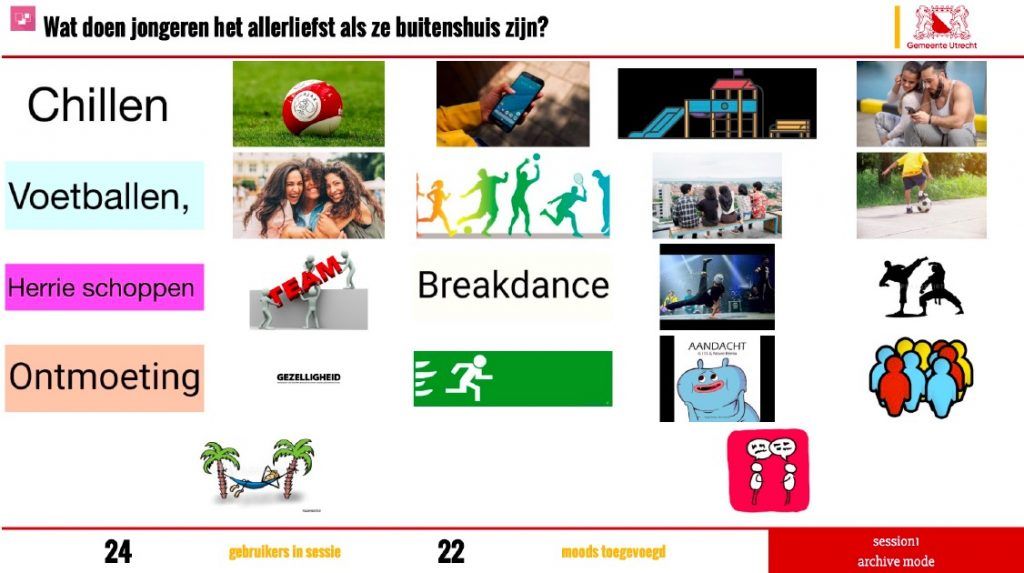
A Moodboard is an interactive format for visual brainstorming, where participants share ideas through images instead of words.
Participants use their phone to select or upload images — for example by searching, taking photos or using their own content. These images appear directly on a shared board, creating a visual collage.
This quickly reveals patterns in atmosphere, preferences and associations within the group. Because people respond visually, the input is often more intuitive and less analytical.
As a facilitator, you can highlight individual images and explore why they were chosen. This helps uncover meaning, differences and shared perspectives.
This makes the Moodboard especially suitable for exploring subjective topics such as experience, style or direction, and for deepening the conversation.
A good Moodboard question invites participants to respond intuitively.
Instead of asking for opinions or arguments, focus on perception, feeling or association. For example, ask what best represents a situation, experience or future vision.
Keep the question open and clear, so participants can quickly choose or upload an image that fits their perspective.
Yes, participants can upload their own images.
In addition to selecting from available images, they can choose a photo from their own device. This allows them to express their perspective more personally and specifically.
This often leads to richer and more diverse input.
As a facilitator, you guide the interpretation of the images.
Start by letting participants select or upload their images. Then explore the results by asking why certain images were chosen and what they represent.
You can highlight individual images and use them as starting points for discussion. Focus on meaning, differences and patterns rather than on right or wrong answers.
Keep the question clear and give direction.
If the topic is too broad, participants may choose very different types of images, making it harder to interpret the results. By focusing the question, you create more meaningful input.
As a facilitator, help by asking follow-up questions and connecting images to the topic of the session.